What is the Bible?
The Christian Bible is made up of the Old Testament (Israel’s history and prophets) and New Testament (Jesus’s life and instructions for the early church).
Originally, the Bible was made up of stories and letters passed down through generations, then compiled into its current form around 1700 years ago.
Through diverse authors and times, these books unite to reveal God’s character and his redemptive plan for humanity.
Why are there so many versions of the Bible?
The Bible was originally recorded in the language of the people. Throughout history, translators have worked at making the Scriptures available to people in the most accessible way possible.
The first (Old) testament was recorded mainly in Hebrew for Hebrew-speaking people. But, when the Greek-speaking Roman Empire took control of Israel, the more common language became Greek. So, a group of seventy-two Hebrew translators (six from each of the Twelve Tribes of Israel) went to work translating the Hebrew Scriptures into Greek. This was later called the Septuagint. Some of it was also translated and paraphrased in Aramaic, as that was also a common language at the time.
When the Christian Bible was finalized and as Christianity started to spread beyond the Greek-speaking world, more translations of both the Old and New Testaments were created. This included Coptic, Ethiopian, Gothic, and Latin. In 405 St. Jerome finished translating a Latin version that was based in part on the Septuagint, and this version, the Vulgate, despite errors introduced by copyists, became the standard of Western Christianity for over a thousand years.
Most people could not read it, so they relied on those who could to teach it to them. Jerome’s Latin Vulgate served as the basis for translations of both the Old and New Testament into Syriac, Arabic, Spanish, and many other languages, including English.
The first complete English-language version of the Bible dates from 1382 and was credited to John Wycliffe and his followers. But it was the work of the scholar William Tyndale, who from 1525 to 1535 translated the New Testament and part of the Old Testament, that became the model for a series of subsequent English translations. All previous English translations culminated in the King James Version (1611; known in England as the Authorized Version), which was prepared by 54 scholars appointed by King James I. Avoiding strict literalism in favour of an extensive use of synonym, it was a masterpiece of Jacobean English and the principal Bible used by English-speaking Protestants for 270 years.1
About the time of the invention of mass printing in 1450, there were about 30 different translations of the Bible. According to Wycliffe Bible Translators, about 10% of the world’s 7,398 languages have a complete Bible and about 50% have a translation started. There are over 450 different versions in English alone! So…
Which one is best?
The short answer is, the best version is the one you will read.
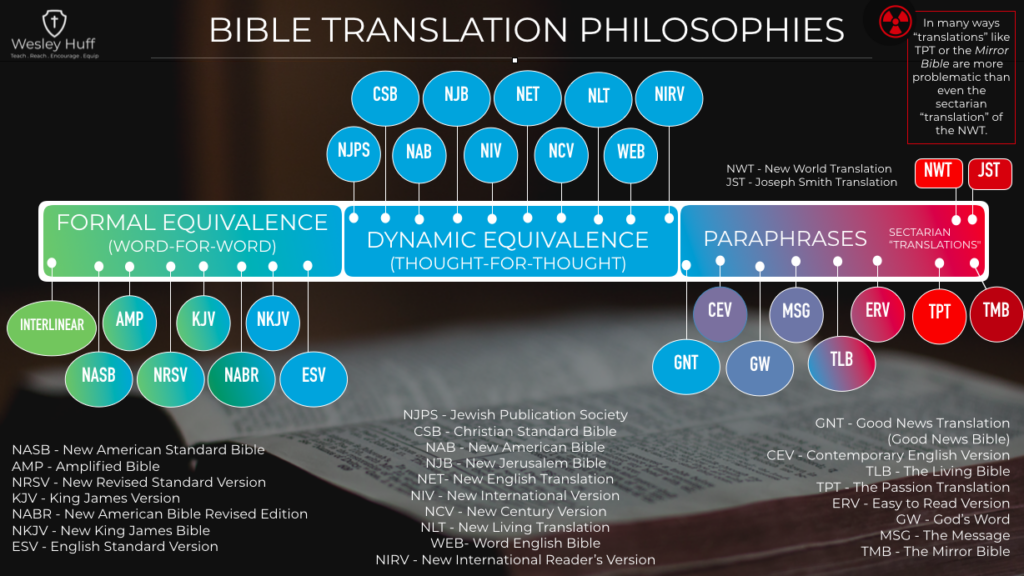
The long answer is, it depends on why you’re reading it. If you are reading it to get to know the story (which is the best way to read it, in my opinion!), I recommend a version that flows well and is more thought-for-thought than literal word-for-word. Two good options in this category are the New International Version (NIV) and the New Living Translation (NLT).
I also recommend buying what’s called a readers version, which takes away the extra stuff like the numbering system, and flows more like a novel than a reference book.
If you’re reading the Bible for the purpose of studying, I recommend a more word-for-word version, such as the New American Standard Bible (NASB) or the New Revised Standard Version (NRSV). These do not flow as well and take a little more effort, but they render the original text with as little interpretation as possible.
The fact is, all translations use interpretation unless they are what is called an interlinear translation, which does not concern itself with how much it makes sense in English. Those translations simply take the original Hebrew or Greek word and provide the most likely English equivalent. Even in interlinear translations, the translator needs to decide which English word is best. So, there is always an element of human reason and discernment in every translation.
Below is a chart created by Wes Huff, which may be helpful:
Are there any versions to avoid?
All Bible versions have some value, but because we have so many to choose from, for your main Bible reading, I recommend sticking with versions that have a solid team of reputable Christian scholars behind it rather than versions that are translated by a small group or a single person. This doesn’t mean avoiding versions such as The Message entirely, but use those versions more as a supplement or commentary, and never rely on them for a final decision on what a passage means.
Other translations to avoid are ones that add or remove sections of the Bible, or have a particular agenda or theology that departs from Christian orthodoxy (right thinking). You can see some of the versions in the chart above, which are red in colour and labeled as sectarian “translations”.
How to read the Bible
A common approach to the Bible is to treat it as an instruction manual, reference material, or moral guide for how to get to heaven. While the Bible does contain instructions and tells us about God’s plan for eternal life, it is best treated more as a source of wisdom. The Bible was not written to answer all our questions, especially around contemporary issues such as climate change, gender pronouns, artificial intelligence, or how much screen time my five-year-old should have.
But, the Bible does help us approach these issues with wisdom. It does this by helping us know what God is like and what we are meant to be like as his image-bearers. It also transforms us in co-operation with the Holy Spirit. In this way, the Bible is a living book. It is not mere information, but it is the transformative, life-giving word of God.
In short, the wisdom contained in the Bible is meant to transform us so that we become what we are meant to be: good image-bearers of God.
With that in mind, here is a suggestion for how you can start reading the Bible:
- Start with the Gospel of John to get to know Jesus.
- Read Genesis and Exodus to get to know the history of God’s people.
- Then read Hebrews and Romans to understand how that history connects to Jesus (disclaimer: these two books are challenging. Don’t be discouraged! Just read through them and come back to them again after reading the rest of the Bible.)
- Next, you might want to read Deuteronomy, as it summarizes God’s instruction for the Israelites as they prepare to enter the Promised Land, and then read Joshua for the rest of that story.
- In addition, it is helpful to read one chapter daily from the Psalms as a prayer guide during devotion time.
What about a chronological reading of the Bible?
A common approach to a Bible reading plan is to read it in the order of when things actually happened. There are Bibles you can buy that publish the books in “chronological order.” This can be an interesting way to read it, but the truth is, some of the timing is a bit of a guess, such as the story of Job, which fits better in between Genesis chapter 11 and chapter 12, chronologically. And, most of the prophets, such as Isaiah, Jeremiah, and Ezekiel, occur in the midst of the stories contained in other books. So, it requires jumping around quite a bit. If you are looking for a good chronological Bible, the Tyndale One Year NLT is a good option.
- https://www.britannica.com/topic/biblical-translation, accessed Dec. 9, 2025. ↩︎